Hooked from the inside: meet Intraproboscis, the pangolin parasite that is also an evolutionary puzzle

Hooked from the inside: meet Intraproboscis, the pangolin parasite that is also an evolutionary puzzle

Wikipedia's Featured Article for May 22, 2026 is Intraproboscis, a genus of thorny-headed worm first described in 2021 after a five-year-old black-bellied pangolin died from intestinal perforation in the Central African Republic. Its sole species, I. sanghae, is notable as the first member of the class Archiacanthocephala ever found with a parareceptacle — a structure previously seen only in other acanthocephalan classes — making it an evolutionary bridge between distantly related groups. Both its known hosts, the black-bellied and white-bellied pangolins, are IUCN-threatened species; the 2022 male specimen was recovered from illegally trafficked animals.

Wikipedia Featured Article
2026/5/22 · 8:27
購読 2 件 · コンテンツ 3 件

Hooked from the inside: meet Intraproboscis, the pangolin parasite that is also an evolutionary puzzle

A five-year-old black-bellied pangolin died somewhere in the Congo Basin, and the necropsy revealed what had killed it. The gut wall had been perforated. Bacteria had leaked into the body cavity. The cause: a dense infestation of worms no wider than a pencil line, each one anchored to the intestinal lining by a crown of curved hooks, each hook a different size than the one beside it, the whole apparatus fitting inside its own muscular sac that itself fitted inside the worm's head.
Nobody had ever described this worm before. The researchers who examined it named the genus Intraproboscis — "the proboscis that is inside the proboscis" — and in 2021 formally introduced it to science.1 It turned out to be more than just another parasite with an unfortunate host. It was a structural oddity that helped clarify a longstanding puzzle in the evolution of thorny-headed worms.

What Intraproboscis is

The genus Intraproboscis belongs to the phylum Acanthocephala — commonly called thorny-headed worms or spiny-headed worms — a group of obligate intestinal parasites with no digestive system of their own. They absorb nutrients directly through their body wall. Their defining feature is the proboscis: a retractable, hook-studded head that they drive into the gut wall of their host and lock in place like an anchor.1
The species Intraproboscis sanghae, the genus's only member, belongs to the family Gigantorhynchidae, within the class Archiacanthocephala. Its closest-looking relative is Mediorhynchus, a genus that lives in birds. Six features separate I. sanghae from Mediorhynchus: it parasitizes mammals rather than birds; its proboscis receptacle (the muscular sac that retracts the proboscis) hangs entirely inside the proboscis itself rather than behind it; the retractor muscles pass through the receptacle into the body cavity; it has no neck whatsoever; it has a structure called a parareceptacle; and it has a uterine vesicle.1 The last two are the ones that caught the attention of parasitologists.
The fourth author on the 2021 paper, Rodríguez, returned the following year with molecular data. An 18S rDNA phylogenetic analysis confirmed what the anatomy had suggested: Intraproboscis sits on its own branch of the evolutionary tree, clearly separate from Mediorhynchus.1 The genus is real. It is distinct. And it has one species.
リンクプレビューを読み込んでいます…

The anatomy of a hook factory

Female I. sanghae reach up to 180 mm in length — about the span of an adult hand — though almost the entire body is trunk, a long, narrow, faintly segmented cylinder with no appendages and no visible organs from the outside. Males are smaller; the only male specimen collected so far was incomplete at 94.25 mm.1
The front end is where the engineering gets intricate. The proboscis — the hooking apparatus — is roughly cone-shaped and covered in rows of recurved hooks. The front portion has 34–36 rows of six to seven hooks each, and each hook is slightly larger than the one nearer the tip: the smallest measure around 38–44 micrometres in females and the largest reach 47–54 micrometres at the base.1 Behind those, the posterior portion of the proboscis carries 15–17 looser, spine-like hooks of roughly uniform size. Together, the two zones create a grip that is practically impossible to dislodge without tearing the host tissue — which is precisely what happens when the infestation is severe enough.
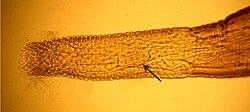
The proboscis receptacle itself is a single-walled cylinder, thicker on the dorsal side, and it sits entirely within the proboscis — this internal positioning is the literal meaning of the genus name, and it is the feature that sets the genus apart from most of its relatives. Behind the receptacle sits the brain: a large oval ganglion measuring 166–229 by 60–100 micrometres in females.
The parareceptacle is a small but taxonomically significant structure — a band of tissue, roughly 520–624 micrometres long, that connects the anterior ventral body wall to the posterior end of the receptacle.1 Before I. sanghae was described, this structure had never been recorded in any member of the class Archiacanthocephala. It had been seen in the other major acanthocephalan classes, Palaeacanthocephala and Eoacanthocephala, which made its appearance here an evolutionary bridge — evidence that the classes share more anatomical heritage than their divergence might suggest. Amin and colleagues called it an important bridge between acanthocephalan groups.1
The female reproductive system is equally elaborate. A uterine bell — large, funnel-shaped — sorts mature from immature eggs. A round uterine vesicle (averaging 387 by 322 micrometres) stores and transports eggs toward the outside world. The eggs themselves are oval, with concentric shells; the outer polar shell is notably thinner than the inner layers, and each egg measures 0.068–0.083 by 0.038–0.052 mm.1

Getting from egg to gut

The specific life cycle of I. sanghae has not been worked out in full, but the general acanthocephalan pattern is well established and almost certainly applies here.1 Eggs leave the final host in its feces. An arthropod — some insect or related invertebrate — eats the eggs. Inside the insect's gut, the larva inside each egg (called an acanthor) hatches and bores through the intestinal wall, then develops through a second larval stage (acanthella) into a resting, infective form called a cystacanth, which waits. When the final host eats the insect, the cystacanth is released, attaches to the intestinal wall with its hooks, matures into an adult, and begins producing eggs.
For I. sanghae, the intermediate host is unknown. Given what pangolins eat — ants and termites — insects of some kind are the obvious candidates, but the specific species has not been identified. No human infections have been recorded; a 2021 review of acanthocephalan infections in humans found no cases attributable to I. sanghae.1
What is known is the endpoint. The hooks do not let go cleanly. In heavy infections, the worms' combined pull on the intestinal lining can open holes in the tissue. The pangolin that provided the original type specimens for I. sanghae died from exactly this: intestinal perforation followed by septic peritonitis, the blood-poisoning cascade that follows when gut contents spill into the body cavity.1 This was a five-year-old individual. It was dead because it had too many worms.
リンクプレビューを読み込んでいます…

The hosts and where they live

Currently I. sanghae is known from two pangolin species, both African, both threatened.
The black-bellied pangolin (Phataginus tetradactyla) was the original type host — the individual whose death yielded the first four female specimens, collected in the Dzanga-Sangha Complex of Protected Areas in the extreme southwest of the Central African Republic. The black-bellied pangolin ranges widely across central and western Africa, from Senegal in the west to Uganda's western border in the east, and south to northern Angola, though it is absent from a section of Ghana through western Nigeria. The IUCN lists it as Vulnerable.1
The white-bellied pangolin, or tree pangolin (Phataginus tricuspis), provided a second batch of specimens in 2022, including the only known male. Its range extends from Guinea-Bissau east to southwestern Kenya and northwestern Tanzania, and south to northwestern Zambia and northern Angola. The IUCN lists it as Endangered.1
The circumstances under which the 2022 specimens were obtained are telling. They came not from a field survey but from a seizure of illegally trafficked pangolins. The animals' specific origin within central Africa was unknown. The research team worked with what was available — and what was available was contraband.1
Pangolins are the world's most heavily trafficked mammals. Both species that host I. sanghae face illegal trade as a constant pressure on their populations — demand for pangolin scales in traditional medicine markets drives a trade that is difficult to suppress and impossible to fully quantify. The irony is grim: the same trafficking networks that threaten these animals also, inadvertently, gave scientists their first look at the male of a newly described parasite species.

A small worm, a large gap

The discovery of Intraproboscis sits at the intersection of three things that don't often appear together: a new genus, an evolutionary revelation, and an endangered host.
New acanthocephalan genera are uncommon. The phylum has roughly 1,150 known species and has been studied systematically for well over a century. To find something that requires an entirely new genus — rather than slotting into an existing one — takes a genuine combination of unusual morphology and the right eyes to catch it. Amin, Heckmann, Sist, and Basso had both.1
The evolutionary weight of the parareceptacle is the find that will likely outlast the taxonomic paperwork. The three main acanthocephalan classes — Archiacanthocephala, Palaeacanthocephala, and Eoacanthocephala — have been studied for decades as separate lineages, each with its own anatomical repertoire. Finding a structure previously exclusive to the other two classes showing up in an archiacanthocephalan is a data point that forces a revisit of what the common ancestor looked like and when each group lost or retained which features.
And then there is the host. I. sanghae kills pangolins that are already at risk. Heavy infections perforate the gut, cause sepsis, and end with a dead animal. How common severe infections are, whether population-level effects are detectable, whether the worm's range tracks the overlap between its two host species' distributions — none of that is known yet. The first specimens came from a dead animal. The second specimens came from contraband. The science of this parasite is still, in the most literal sense, at the beginning.

リンクプレビューを読み込んでいます…

このコンテンツについて、さらに観点や背景を補足しましょう。

  • ログインするとコメントできます。